Manchester has always understood industry.
From cotton mills to railways, from engineering to music, this city has rarely been frightened of scale, noise, movement or reinvention.
Yet standing inside the Renew Hub in Trafford Park, operated by SUEZ on behalf of Greater Manchester Combined Authority, I found myself thinking that perhaps Manchester’s next industrial revolution will not be about making more things at all.
It may instead be about rescuing the things we already have.
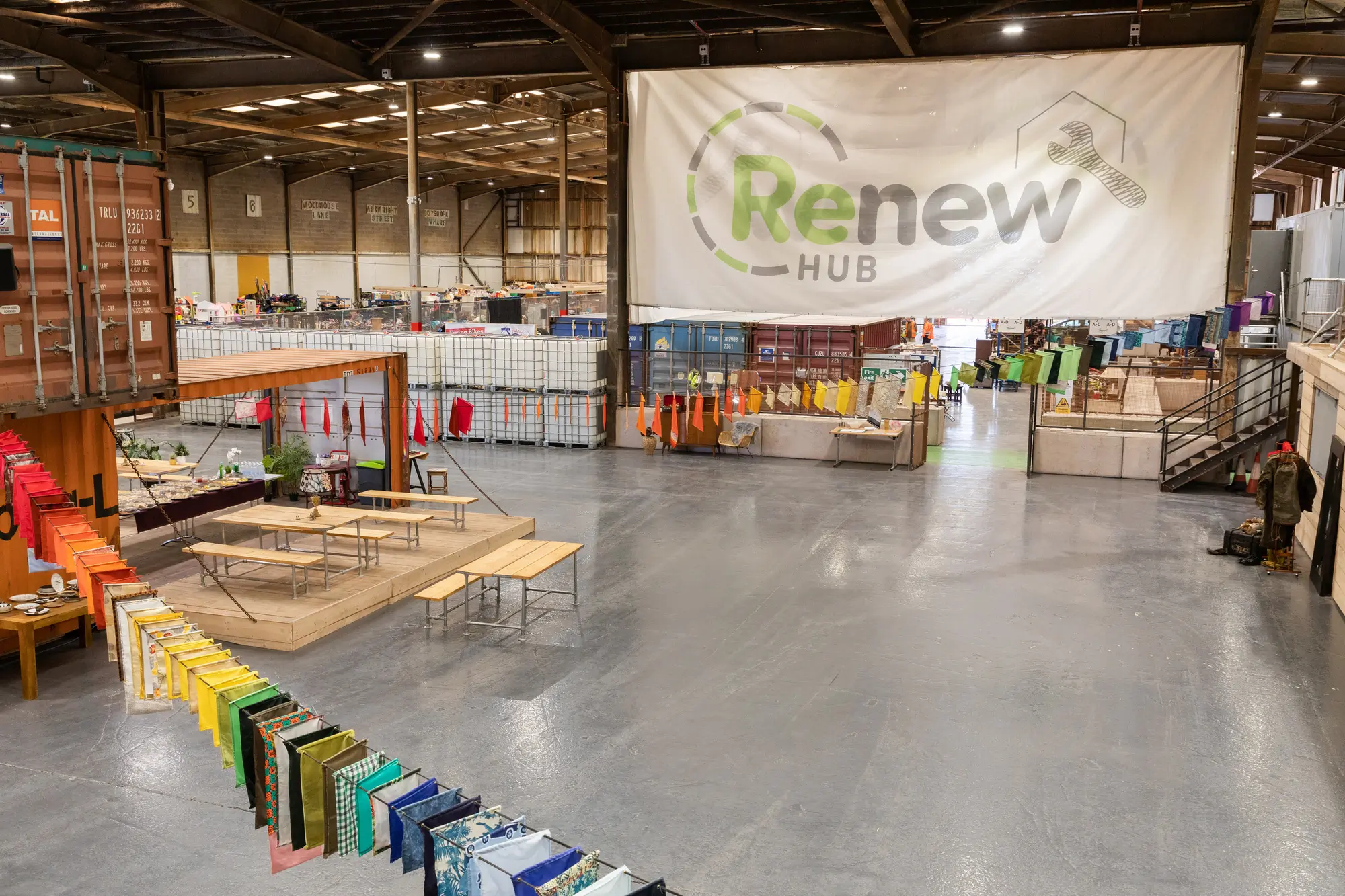
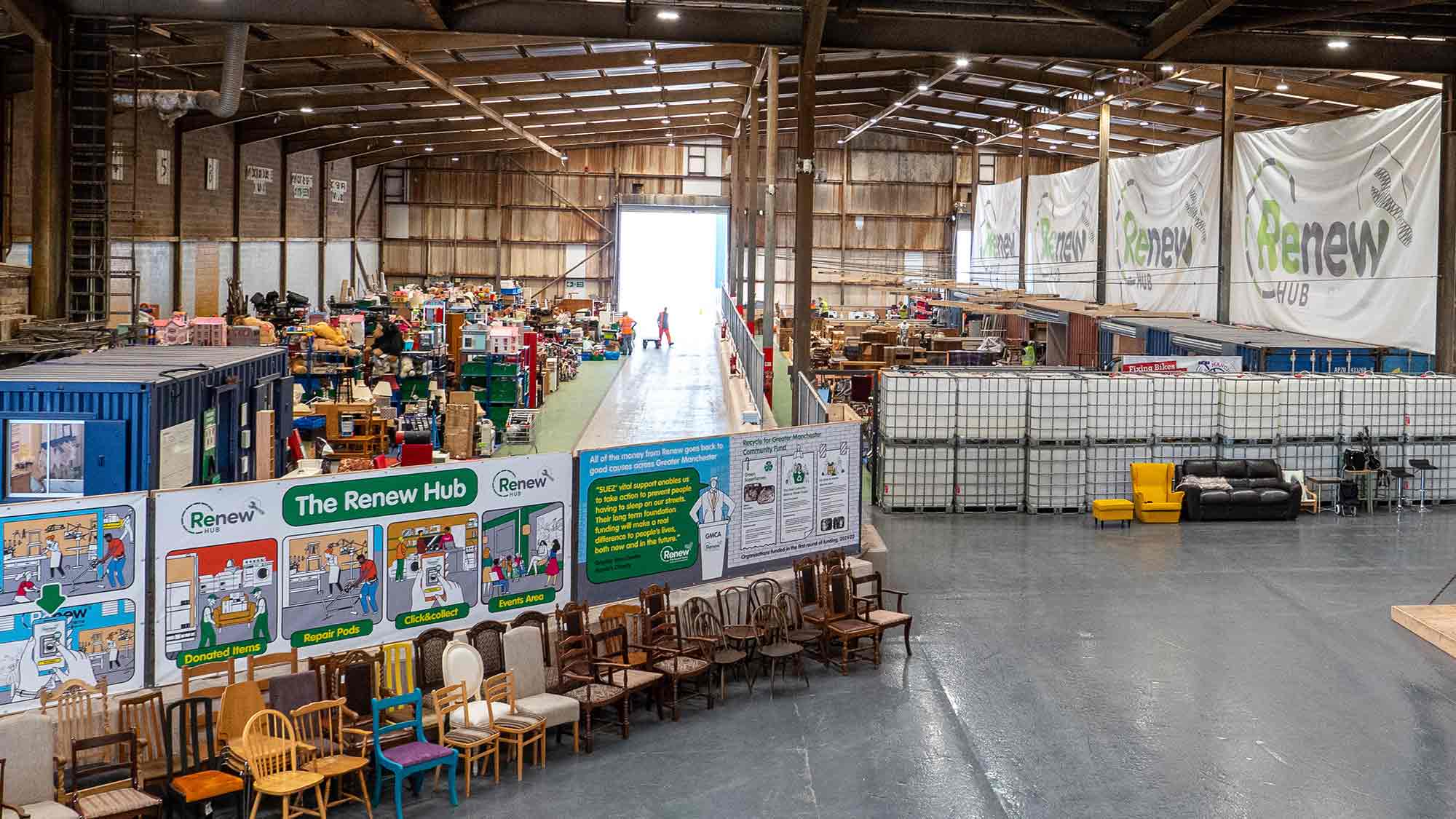
The Renew Hub is, in purely physical terms, a vast warehouse. More than 5,000 square metres of furniture, bicycles, electrical goods, toys, crockery and countless unnamed objects which pass through its doors every year.
But to describe it merely as a waste facility would be rather like calling the John Rylands Library a book shed.
This is a place built around a strikingly simple idea: that value does not disappear simply because somebody has stopped wanting something.
Across Greater Manchester, residents deposit unwanted household items at recycling centres. On arrival there is a “meet and greet” system in place which shifts the emphasis from disposal to renewal.
In most cities, those objects would drift silently towards destruction. Here, they begin a second life.
In the Renew Hub, teams of skilled repairers, restorers, apprentices and volunteers inspect, mend, clean and upcycle them before they are sold through 3 Renew shops, in school halls or online at affordable prices.
Even better still, a huge amount of goods are simply donated to people who need them but who cannot afford them.
The atmosphere is neither frantic nor sentimental. It is purposeful.
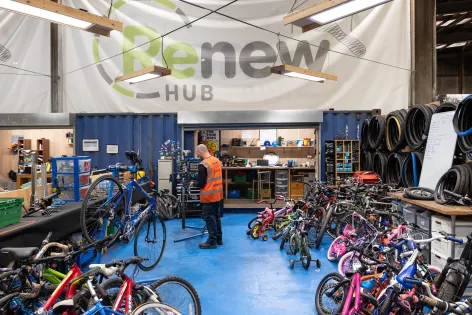
A row of bicycles waits patiently for repair. Nearby, furniture restorers work with the concentration of craftspeople rather than refuse operatives. Electrical appliances are tested methodically for safety and function. The quiet dignity of the work is striking because it challenges one of the central habits of modern consumer culture — the assumption that replacement is always easier than repair.
And perhaps that is the real achievement here.
The Renew Hub does not lecture people about sustainability. It demonstrates it.
There is something deeply persuasive about seeing an old oak sideboard being carefully restored instead of smashed and burned.
Something quietly hopeful about watching a child’s bicycle being repaired for another family rather than crushed for scrap metal.
Circular economy is an abstract phrase until you stand in a building where it is physically happening all around you. Then you get it!
Strangely, it also reconnected me with my grandparent’s generation, a society who reached parenthood during the second world war, who had to “make do and mend” and who railed against the modern concept of built-in-obsolescence.
As a young man making my way in business in the (in retrospect hideous) late 80’s I was sniffy and dismissive of this attitude.
Forgive me, I was young!
Size matters!
The scale of the operation is impressive. The ambition is staggering.
Since opening in 2021, hundreds of thousands of items have been diverted from waste streams and returned to use across Greater Manchester.
£2.2m has also been channelled back into community projects and charitable initiatives through the programme’s proceeds.
Just as importantly perhaps, green jobs, apprenticeships and practical repair skills are being created in a society that has spent too long undervaluing hands-on expertise.
Yet statistics only tell part of the story.
What lingered with me most was the sense that the Renew Hub represents a different moral relationship with material things.
For decades we have built an economy optimised around disposal. Products became cheaper, lifespans shorter and repair economically irrational.
Entire generations grew accustomed to the small disappointment of throwing away items that still seemed somehow salvageable. “Don’t cry, we will get you a new one” was a mantra of millions of parents from the baby boomers onwards.
The people working at the Renew Hub are quietly rebelling against that logic.
Not through slogans or grandstanding, but through competence.
A repaired toaster. A restored wardrobe. A refurbished laptop. Thousands upon thousands of tiny acts of recovery, each one insisting that usefulness still matters.
Manchester, appropriately enough, understands this instinct.
Reinvention is woven into the city’s character.
Old mills become apartments.
Canals become cultural corridors.
Industrial districts become creative centres.
Derelict no-go zones become community nature parks.
The Renew Hub feels entirely consistent with that civic tradition — except here the reinvention applies not to buildings and neighbourhoods, but to ordinary household possessions.
It’s all about people
There is also something socially important happening beneath the environmental language.
In an era where many households are under severe financial pressure, access to affordable, high-quality reused goods matters enormously.
I was told of one story (likely one of thousands) of a mother who was hopeful that, when the Renew Hub came to her children’s school, she would be able to buy a bike for her oldest child who was due to start a senior school which was not within a walkable distance but a comfortable one on two wheels.
She had two other children. She had a budget.
She left with three perfectly safe, usable bicycles. Her budget?
£10!
Sustainability can sometimes appear as a luxury, discussed most comfortably by those who can afford premium ethical consumption.
The Renew Hub cuts through that tension by making reuse practical, accessible and economically useful.
That may ultimately prove its greatest strength.
Because successful environmental projects are rarely sustained by virtue alone. They endure when they become visibly beneficial to everyday life.
The Renew Hub feels built on exactly that understanding.
It is not just about consumers either.
Before your business discards tonnes of old furniture in favour of a more modern, design appropriate style ask the Renew Hub what their artisans can do for a fraction of the price you planned to pay.
A lesson for us all
As I left Trafford Park, I found myself reflecting on how curious it is that some of the most forward-looking ideas now emerging in the UK involve rediscovering older instincts: repair rather than discard, stewardship rather than carelessness, usefulness rather than novelty.
Perhaps progress is not always about inventing something new.
Sometimes it is about recognising the value that was sitting in front of us all along.
To find out more about this ground-breaking and inspirational project and how your business can get involved through reuse or by taking part in interactive team-building workshops contact me on roger@theebn.co.uk or go direct via renewhub.uk@suez.com
You can also find out more from the web site recycleforgreatermanchester.com/renew